After servicing HVAC systems across the Ocoee area for years, we can tell you something most first-time homeowners learn the hard way: this climate is harder on your system than almost anywhere else in the country. Not because the equipment is worse here — but because it never really rests. While most of the U.S. runs air conditioning seasonally, your Ocoee system runs nearly continuously from April through October, sometimes longer. That changes everything about maintenance timing, filter schedules, and what to watch for.
The calls we get every August — systems that quit on the hottest week of the year — almost always trace back to one of three things: a clogged drain line, a filter that went unchanged too long, or a tune-up that got pushed off indefinitely. None of those failures are inevitable. All of them are preventable with the right routine established early.
If you've just moved in, this guide is what we'd tell you face-to-face.
TL;DR Quick Answers
What Does HVAC Maintenance in Ocoee Actually Require?
Ocoee's near-year-round cooling season runs HVAC systems harder than most of the country. Based on what we see servicing homes across the area:
Two professional tune-ups per year — spring and fall, without exception in this climate.
Filter changes every 30–60 days — oak pollen and continuous operation load filters far faster than national guidelines assume.
Monthly condensate drain treatment — a cup of white vinegar prevents the most common AC service call we respond to in Ocoee.
Indoor humidity between 45–55% RH — above 65%, you're in mold-risk territory in Central Florida.
Budget $150–$300/year for professional service — far less than the cost of the failures deferred maintenance causes.
Top Takeaways
Schedule two professional HVAC tune-ups per year — spring and fall. This is the single highest-ROI maintenance habit for Ocoee homeowners.
Change filters every 30–60 days during peak cooling season — not the 90-day standard used in cooler climates.
Treat your condensate drain line monthly with white vinegar to prevent the algae clogs that cause the most common Florida AC service calls.
Monitor indoor humidity and target 45–55% RH. Above 65% creates mold risk in Central Florida's climate.
If your system is over 10 years old, start budgeting for replacement — Florida's cooling demands shorten system lifespans compared to national averages.
Why Ocoee's Climate Makes HVAC Maintenance Non-Negotiable
Most national HVAC maintenance guides assume moderate climates. Ocoee is not a moderate climate. Average summer temperatures regularly exceed 90°F, and outdoor humidity often sits at 80% or higher during peak months. This means your AC runs for 8–10 months of the year instead of the 4–5 months typical of Northern markets.
What that means practically: your system accumulates wear, dirt, and strain much faster. A filter that might last 90 days in Chicago may need changing in 30 days here. Condenser coils collect organic debris — oak pollen, grass clippings, and mold spores — faster than in drier climates. Drain lines clog with algae growth accelerated by heat and humidity.
These are not hypothetical risks. They are the most common service calls HVAC technicians respond to in Ocoee homes every summer.
The First-Year Maintenance Checklist for New Ocoee Homeowners
When you move into your Ocoee home, your first HVAC priority is understanding what you have. Before your first full cooling season, do the following:
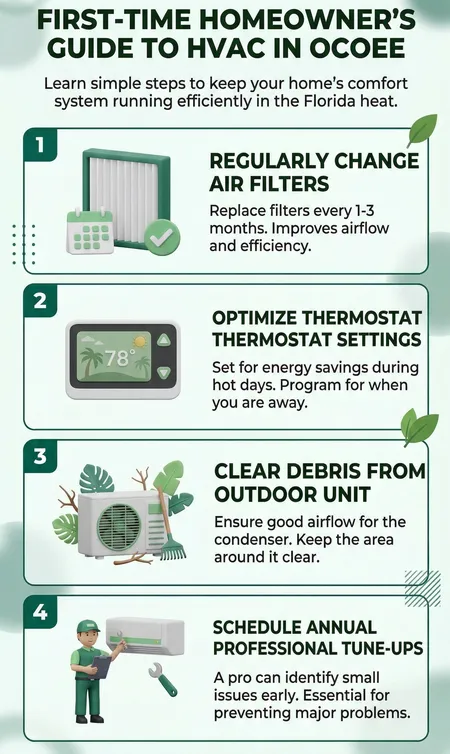
1. Document your system. Find the model and serial number on the indoor air handler and outdoor condenser. Note the manufacture date — units over 10 years old may need closer monitoring.
2. Locate the air filter. Most Ocoee homes use a central return-air filter, typically a 1-inch or 4-inch slot near the air handler. Know your filter size and keep two or three on hand at all times.
3. Find the condensate drain line. It exits the indoor air handler and runs to a floor drain or outside. In Florida, algae loves this line. Learn to pour a cup of white vinegar into the drain port monthly.
4. Check the thermostat. If it's an older model, upgrading to a smart thermostat can save roughly $100/year on utility bills, per ENERGY STAR.
5. Clear the outdoor unit. Remove any debris, mulch, or overgrown vegetation within two feet of the condenser — especially after Ocoee's frequent afternoon thunderstorms.
6. Schedule a professional inspection. Before your first full cooling season, have a licensed HVAC technician perform a 24-point inspection. This establishes a baseline for your system.
Filter Replacement: The Single Most Important DIY Task
In Central Florida, a dirty air filter is the root cause of more HVAC problems than anything else. It restricts airflow, forces the blower to work harder, coats the evaporator coil with dust, and can cause the system to freeze up completely in the middle of summer.
For Ocoee homes, change your filter every 30–60 days during the cooling season (roughly April through October). If you have pets or allergy sufferers in the home, err toward 30 days. Use a MERV 8–11 rated filter for the best balance between air quality and airflow.
Do not use MERV 13 or higher in standard residential systems without first confirming your equipment can handle the increased resistance — very high-efficiency filters can restrict airflow enough to damage your blower motor.
Humidity Management: The Hidden Challenge in Ocoee Homes
High indoor humidity is one of the most overlooked HVAC issues in new homeowners' first year. When your system is properly maintained and sized, it removes moisture from the air as part of the cooling process. When it isn't, indoor humidity creeps up — and in Ocoee's climate, that creates conditions for mold growth, musty odors, and respiratory discomfort.
Target indoor relative humidity between 45% and 55%. Above 65%, you enter mold-risk territory per ASHRAE Standard 62.1. A basic digital hygrometer (under $15 at any hardware store) lets you monitor this in real time.
If your humidity stays consistently above 60% even with the AC running, that is a signal your system may be oversized, undersized, or in need of a refrigerant or airflow check.
When to Call a Professional vs. Handle It Yourself
DIY tasks (every homeowner can do these):
Filter replacement (monthly to quarterly)
Monthly drain line treatment with white vinegar
Clearing debris from around the outdoor condenser unit
Checking thermostat settings and replacing batteries
Monitoring indoor humidity with a hygrometer
Professional service tasks:
Refrigerant level checks and recharges (requires EPA 608 certification)
Condenser coil cleaning and evaporator coil inspection
Electrical connection checks and capacitor testing
Ductwork inspection for leaks or crushed sections
Full 24-point system tune-up (twice yearly)
Understanding HVAC Lifespans in Florida's Climate
In most of the U.S., a well-maintained central AC system lasts 15–20 years. In Florida, that number is closer to 10–15 years due to the extended cooling season and humidity stress on components.
If your Ocoee home's system is already 8–10 years old when you move in, budget for potential replacement within the next 3–5 years. Continuing maintenance is still worth it — a maintained older unit will run more efficiently and give you warning signs before it fails, rather than stopping suddenly at the worst possible moment.
"In Ocoee, we see the same story play out every summer: a family moves in, skips the first tune-up to save money, and ends up calling us for an emergency repair in August that costs five times what the maintenance would have. Florida's climate is genuinely unforgiving to neglected HVAC systems — what goes wrong here goes wrong faster and harder than anywhere else in the country. The homeowners who get ahead of it on day one are the ones who never have to panic."
Essential Resources
1. U.S. Department of Energy — Energy Saver: Heating & Cooling
The DOE's consumer-facing guide covers HVAC efficiency, filter maintenance schedules, smart thermostat savings, and duct sealing guidance applicable to Florida homeowners.
https://www.energy.gov/energysaver/heating-cooling
2. U.S. EPA — Indoor Air Quality (IAQ): Introduction
The EPA's foundational resource on indoor air pollutants, ventilation requirements, and how HVAC maintenance directly impacts the air quality inside your home
https://www.epa.gov/indoor-air-quality-iaq/introduction-indoor-air-quality
3. ENERGY STAR — How to Keep Your HVAC System Working Efficiently
Step-by-step seasonal maintenance guidance from the EPA's ENERGY STAR program, including filter check schedules, pre-season tune-up checklists, and duct sealing tips
https://www.energystar.gov/products/ask-the-experts/how-keep-your-hvac-system-working-efficiently
4. NIST — Sensitivity Analysis of Installation Faults on Heat Pump Performance (TN 1848)
NIST research quantifying how installation and maintenance faults increase home energy use by up to 30%. Essential for understanding why professional service matters
https://www.nist.gov/publications/sensitivity-analysis-installation-faults-heat-pump-performance
5. ASHRAE — Ventilation and Acceptable Indoor Air Quality (Standards 62.1 & 62.2)
ASHRAE's residential ventilation standard, which establishes indoor humidity targets (below 65% RH) and ventilation rate guidelines directly relevant to Ocoee's humid climate.
https://www.ashrae.org/technical-resources/bookstore/standards-62-1-62-2
6. Florida Department of Agriculture and Consumer Services — MyFloridaLicense.com
Verify that any HVAC contractor you hire holds a valid Florida state license. Essential consumer protection for new homeowners evaluating service providers.
https://www.myfloridalicense.com/wl11.asp
7. U.S. EIA — Efficiency Requirements for Residential Central AC and Heat Pumps
Explains current SEER2 efficiency standards for Florida homes (14.3 SEER2 minimum for residential systems), helping homeowners understand equipment standards for replacements.
https://www.eia.gov/todayinenergy/detail.php?id=40232
Supporting Statistics
Stat 1: Heating and cooling accounts for nearly half of the average American household's annual energy bill.
Source: ENERGY STAR / U.S. EPA
In Ocoee, where air conditioning runs nearly year-round, this percentage is almost certainly higher than the national average. For a home with a $200/month utility bill, that means potentially $1,000–$1,200 per year tied directly to the quality of your HVAC system's maintenance. The math on a $150 tune-up versus $1,200+ in preventable waste is not subtle.
Stat 2: Improper HVAC installation or maintenance can increase household energy use for heating and cooling by approximately 30%.
Source: National Institute of Standards and Technology (NIST), Technical Note 1848
This finding is especially relevant to first-time homeowners who inherit a system with an unknown maintenance history. If the previous owner skipped service for several years, your system may already be running 20–30% less efficiently than it should — costing you money every month with no visible failure. A professional inspection that resets refrigerant charge, cleans coils, and checks airflow can recover much of that lost efficiency.
Stat 3: Indoor air pollutant concentrations are often 2–5 times higher than outdoor levels, and Americans spend approximately 90% of their time indoors.
Source: U.S. EPA — Introduction to Indoor Air Quality
In Ocoee, where homes are sealed against heat and humidity for most of the year, indoor air quality depends almost entirely on HVAC filtration. A dirty filter or unmaintained ductwork means the air your family breathes daily may carry 2–5 times the dust, pollen, and biological contaminants of outdoor air. Regular filter changes and annual duct inspections are a health measure, not an optional upgrade.
Final Thought & Opinion
First-time homeownership in Ocoee is one of the best investments you can make — and your HVAC system is one of the largest components of that investment. The homeowners who protect it well from the beginning are the ones who avoid the expensive, stressful surprises that tend to define a difficult first year.
In our experience working with Central Florida homeowners, the biggest difference between comfortable, low-stress ownership and recurring frustration almost always comes down to maintenance habits established in year one. Once you've seen what a neglected system costs versus a maintained one — in dollars, in comfort, and in peace of mind — the choice is clear.
Key practical advice for your first year in Ocoee:
Do not skip your first professional tune-up. Start your system's history with a documented baseline inspection.
Change filters monthly during peak summer. In Florida, this is the right schedule.
Treat your condensate drain proactively. A cup of white vinegar monthly prevents the most common Florida HVAC call.
Install a digital hygrometer. Knowing your indoor humidity is the fastest way to spot a developing problem early.
Keep records. Every service visit, filter change, and repair is documented, which protects your home's value.
FAQ on "HVAC Maintenance in Ocoee"
Q1: How often should I schedule professional HVAC maintenance in Ocoee?
A: Twice per year — once in spring (March or April) before peak cooling season, and once in fall. In Ocoee's climate, where your AC runs nearly year-round, this is the minimum. If your system is older or you've noticed rising utility bills, consider adding a mid-summer check.
Q2: Why do my filters need changing more often in Florida than the package suggests?
A: Most filter packaging assumes a moderate climate with a system running 4–6 months per year. In Ocoee, your system runs 8–10 months, pulling in air laden with oak pollen, humidity, and organic debris. A filter that lasts 90 days in Minnesota may be fully clogged in 30–45 days here.
Q3: What is a condensate drain line and why does it keep clogging?
A: The condensate drain line carries moisture removed from your indoor air to the outside or a floor drain. In Florida's warm, humid climate, algae grows rapidly inside the line during summer months. Monthly treatment with white vinegar keeps it clear. Left untreated, clogs back up water into your air handler, triggering the float switch and shutting the system down.
Q4: How do I know if my HVAC system is the right size for my Ocoee home?
A: An oversized system short-cycles — it cools the air quickly but doesn't run long enough to remove humidity, leaving your home feeling damp even at low temperatures. An undersized system runs constantly and still can't keep up on the hottest days. If either describes your experience, ask a licensed technician to perform a Manual J load calculation.
Q5: What is the typical HVAC lifespan in Ocoee, and how does maintenance affect it?
A: In Ocoee's climate, expect 10–15 years from a central AC system with regular maintenance. Neglected systems often fail after 8–10 years. The difference is significant: a $5,000–$12,000 replacement versus $300/year in maintenance. Consistent maintenance provides warning signs and the extra years to plan.
Ready to Protect Your Ocoee Home?
If you've just moved into your Ocoee home and haven't scheduled your first professional HVAC inspection, now is the right time — before the heat of summer reveals what you don't know about your system.
Schedule a tune-up with a licensed local HVAC technician serving the Ocoee area and get a clear picture of your system's condition, efficiency, and what to watch for in the year ahead.
Here is the nearest branch location serving the Ocoee area. . .
Filterbuy HVAC Solutions
2900 Titan Row # 128, Orlando, FL 32809
(407) 204-1859
https://maps.app.goo.gl/NL6cB91PWLscgQkaA